Every Alabama vacation rental agreement needs five things to hold up legally and protect your income: a valid local rental license, clear lodgings tax language, defined occupancy and rental-period terms, a documented deposit and cancellation policy, and signed house rules tied to local ordinances. Start by pulling an Alabama-specific template rather than a generic one, then confirm your city license and tax account are active before you send a single contract to a guest.
TL;DR:
- Alabama requires short-term rentals under 180 days to include clear lodgings tax language, which can total up to 13% after local add-ons, to avoid disputes and ensure proper tax remittance.
- Gulf Shores mandates that each vacation rental have a current, address-specific license, pass periodic safety inspections, and designate a local emergency contact for license renewal and compliance.
- Rental agreements must specify property details, occupancy limits, payment breakdowns, cancellation policies, house rules matching local ordinances, and insurance advice to be legally sound.
- Starting January 1, 2025, booking platforms or intermediaries are generally responsible for collecting and remitting lodging taxes, unless a written contract assigns this duty to the property owner.
- Hosts should verify licensing, insurance, and tax registration details before sending contracts and use digital signatures to archive signed copies for at least three years.
Table of Contents
- Alabama Vacation Lease Basics: Lodgings Tax and the 180-Day Rule
- Local Licensing Rules: What Gulf Shores Requires (and What It Means for You)
- The Clauses Your Alabama Rental Contract Can’t Skip
- Who Actually Collects the Tax: Provider vs. Intermediary
- Building Your Agreement: Fields to Fill and a Pre-Signing Checklist
- A Sample Tax and Deposit Clause You Can Adapt
- A Local Host’s Take on Getting the Paperwork Right
- List a Compliant Rental Without Starting From Scratch
- Official Resources to Verify Licensing and Tax Rules
- Sources
- FAQ
Alabama Vacation Lease Basics: Lodgings Tax and the 180-Day Rule
Alabama treats any rental under 180 continuous days as taxable lodging, which covers nearly every vacation home, condo, or cottage booked on a weekly or monthly basis. Marine slips, campsites, and RVs get a shorter, 90-day window before the tax exemption kicks in, according to the Alabama Department of Revenue. That distinction matters if you rent a mix of property types, since a boat slip attached to your Gulf Shores condo follows different rules than the unit itself.
The state rate alone is modest, but combined with municipal and county add-ons, guests can face a total lodgings tax ranging up to around 13% depending on where the property sits. Your rental agreement should spell this out rather than bury it in a lump sum, for a few reasons:
- It shows guests exactly what portion of their bill is tax, which cuts down on disputes at checkout.
- It creates a paper trail if the Alabama Department of Revenue or a local auditor ever asks for documentation.
- It keeps your books clean when you file, since returns are generally due by the 20th of the month following the rental, with options for quarterly, biannual, or annual filing available based on tax liability.
Local Licensing Rules: What Gulf Shores Requires (and What It Means for You)
Alabama does not run a single statewide vacation rental license. Cities set their own rules, and Gulf Shores offers one of the clearest working examples of what to expect anywhere along the coast.
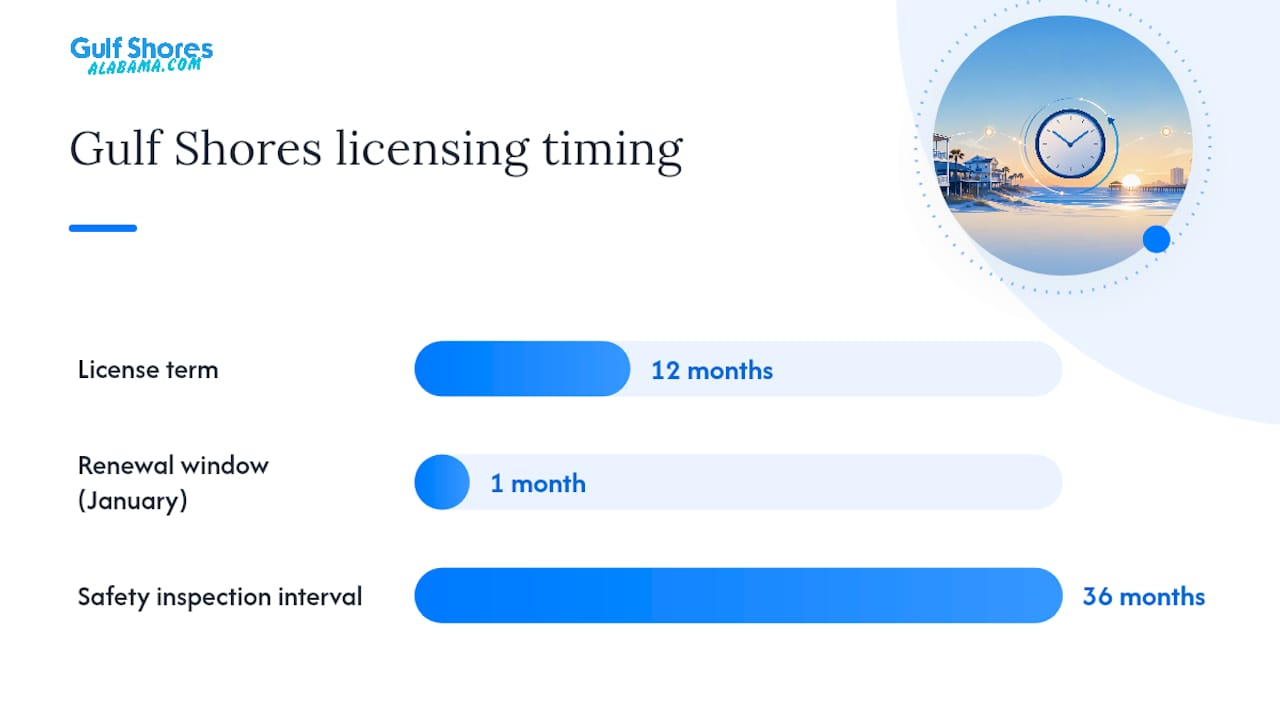
Gulf Shores requires every short-term rental to carry a location-specific rental license tied to that exact address, not to the owner generally. The city’s licensing office charges a fee based on gross receipts plus a flat $45 per dwelling unit, and licenses expire December 31 each year; renewals are due by January 1 and considered delinquent if received after January, so hosts who wait until the new year to renew are already running behind.
Three things to check before your agreement ever reaches a guest:
- Zoning eligibility. Vacation Rental Dwelling Units are only permitted in specific overlay and zoning districts under Gulf Shores’ ordinance; operating unlicensed or outside an approved district is prohibited citywide.
- Safety inspections. The city requires periodic inspections every three years, tied directly to license renewal.
- Local emergency contact. You must designate a real person reachable locally, and failing to maintain one can trigger license revocation.
Pro Tip: Keep a digital copy of your current rental license and post it where inspectors and booking platforms can find it fast. A missing or expired license is one of the quickest ways to lose your right to operate, even mid-season.
The Clauses Your Alabama Rental Contract Can’t Skip
A solid Alabama vacation lease is really a checklist wearing legal language. Here’s what belongs in every version, whether you’re renting a downtown condo or a Fort Morgan cottage.
Identification and property details. Name both parties, list the exact property address, and confirm the unit sits in a zoning district that permits vacation rentals before you ever advertise it.
Rental period and occupancy. State check-in and check-out times, maximum occupancy, and the total length of stay. Since Alabama’s lodgings tax threshold is 180 continuous days, keeping stays well under that window preserves your classification as a taxable short-term rental rather than triggering a different tenancy category.
Payment terms. Break out the nightly rate, cleaning fee, and security deposit as separate line items, and specify which amounts are refundable. Combined state and local lodgings taxes can run as high as around 13% in some Alabama municipalities, so showing that figure as its own line avoids confusion when guests review their final charge.
Cancellation and damage holdbacks. Spell out your refund window, what counts as a cancellation versus a no-show, and how damage deductions get calculated and returned.
- Define a specific number of days before check-in for a full refund.
- State how long you have to inspect for damage and issue any deposit refund.
- Note whether disputes go to mediation, small claims court, or another process.
House rules. Noise curfews, party restrictions, and posted occupancy limits should mirror your city’s actual ordinance language, not just your personal preference.
Insurance. Advise every host, including yourself, to confirm commercial or short-term rental coverage. Standard homeowner policies frequently exclude rental business activity entirely, which means a claim filed after a guest incident could be denied outright.
Who Actually Collects the Tax: Provider vs. Intermediary
Alabama’s tax rules changed in a way that catches a lot of hosts off guard; for an explanation of how intermediary models impact tax collection, see Taxe de séjour Airbnb : qui collecte quoi, et comment res…. Under Rule 810-6-5-.22.01, the state now distinguishes between an “accommodations intermediary” (think a booking platform or property manager) and an “accommodations provider” (typically you, the owner).
Starting with transactions on or after January 1, 2025, intermediaries must collect and remit lodging taxes automatically, unless a signed written agreement specifically assigns that duty to the provider instead. That written agreement piece is the part your rental contract needs to nail down. Alabama’s own tourism tax guidance flags this shift as a common source of double taxation and reporting errors when contracts stay silent on the issue.
Your agreement should include language along these lines:
- Which party (owner or booking platform) is responsible for collecting and remitting lodgings tax on this specific reservation.
- How receipts and tax collected will be documented and shared between the parties.
- A note that annual informational reports are due April 20, with the first cycle covering 2025 transactions due in April 2026.
Building Your Agreement: Fields to Fill and a Pre-Signing Checklist
Once you have a template, populate it carefully. Fill in your license number, local emergency contact name and phone number, the exact property address as it appears on your license, payment routing details, and how the security deposit will be held and returned.
Before sending anything to a guest, run through this checklist:
- Confirm your zoning district and license are both current and match the property address.
- Verify you carry short-term rental insurance, not just a standard homeowner policy.
- Check that your lodgings tax account is registered and active with the state.
- Confirm your safety inspection is up to date under your city’s cycle.
- Double-check occupancy limits match what’s posted on your license.
Pro Tip: Use e-signature software to collect signed agreements and store them for at least three years. If a city inspector or the Alabama Department of Revenue ever asks for proof of a signed contract, you want that document ready in under a minute, not buried in an old email thread.
A Sample Tax and Deposit Clause You Can Adapt
Here’s a short clause you can build from: “Guest agrees to pay a security deposit of $[amount], refundable within [X] days of check-out less any damage costs. Lodgings tax of [combined rate]% will be itemized separately and remitted by [Owner/Intermediary name and license number] per Alabama Rule 810-6-5-.22.01.”
Replace the bracketed fields with your actual license number, the filing party’s name, and your specific combined tax rate. Keep a copy of every signed version for your own records, since that’s exactly what ALDOR reporting will ask you to produce.
A Local Host’s Take on Getting the Paperwork Right
Hosts along the Gulf Coast tend to learn the hard way that a vague contract costs more than a strict one. The biggest mistake isn’t skipping a clause. It’s copying a generic lease from another state and assuming Alabama’s licensing and tax rules will just sort themselves out later.
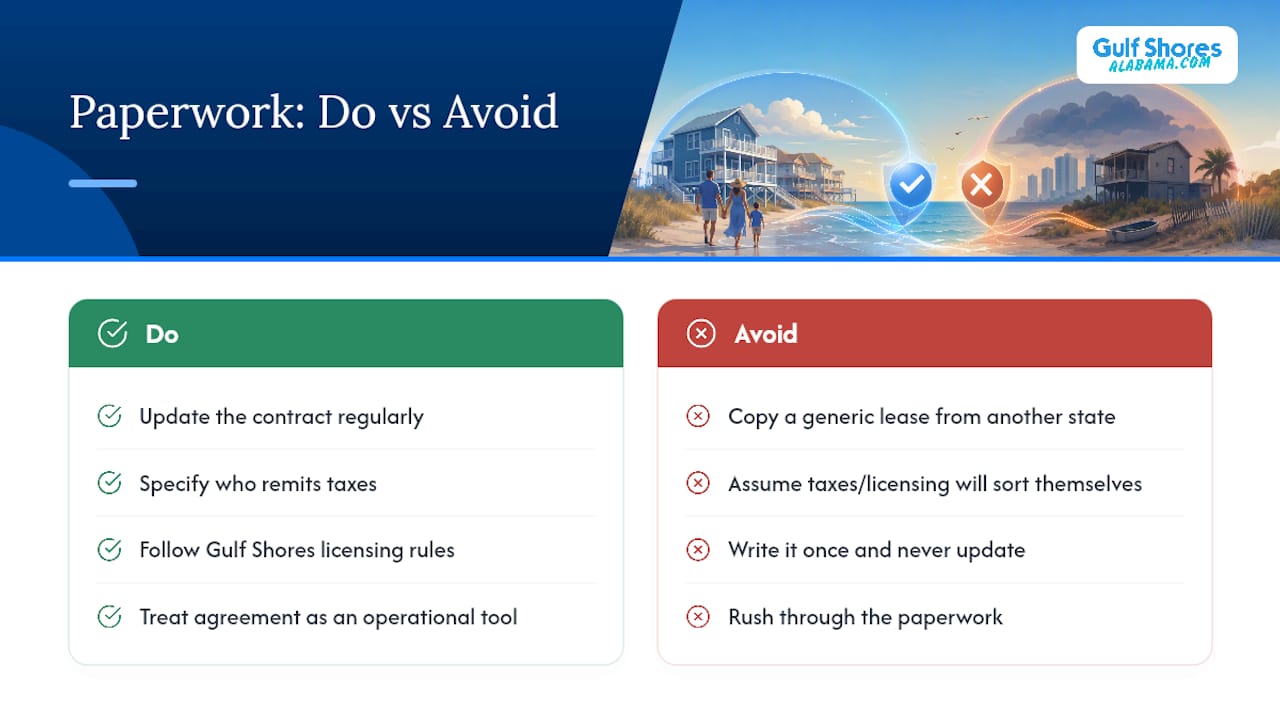
They won’t. Gulf Shores enforces its licensing ordinance closely, and the 2025 shift in intermediary tax collection means owners who don’t spell out who remits taxes are gambling with double payments or missed filings. Gulf Shores Vacation Rentals lists everything from luxury beachfront condos to quiet Gulf-front cottages, and the properties that rent smoothly year after year are almost always the ones whose owners treat their rental agreement as an operational tool, not paperwork to rush through.
The owners who struggle are usually the ones who wrote their contract once in year one and never touched it again, even as local ordinances and state tax rules shifted underneath them. Alabama’s rental rules move. Your agreement should move with them.
— Joe
List a Compliant Rental Without Starting From Scratch
Writing a compliant Alabama rental agreement is only half the job. Getting your property in front of travelers who are actually ready to book is the other half, and that’s where a marketplace built specifically for the Gulf Coast earns its place. Gulfshoresalabama connects owners in Gulf Shores, Orange Beach, and Fort Morgan directly with travelers, with no guest service fees standing between your listing and a booking.
Whether you’re managing a single beachfront condo or a small portfolio of pet-friendly cottages, you can list your property alongside homes ranging from budget-friendly getaways to full luxury rentals, and communicate with guests directly rather than through layers of platform overhead. If you want to see how current listings present their terms and amenities, browse an active Gulf Shores rental to get a feel for what travelers expect before you finalize your own contract. You can reach out through a website to start the listing process.
Official Resources to Verify Licensing and Tax Rules
Confirm current rates and requirements directly with the Alabama Department of Revenue lodgings tax page and the Gulf Shores rental license portal before finalizing any agreement.
Sources
- Transient Occupancy (Lodgings) Tax - Alabama Department of Revenue
- Rental License | Gulf Shores, AL - Official Website
- Rule 810-6-5-.22.01 - Collection and Reporting Requirements for Accommodations Intermediaries and Accommodations Providers
Recommended
- Short-Term Rental Laws Gulf Shores Owners Must Follow
- Property Management Gulf Shores AL: 2026 Owner’s Guide

About the Author
Joe Godar of the GulfShoresAlabama.com Editorial Team creates destination guides, vacation-planning resources, and local travel content focused on Gulf Shores, Orange Beach, and Fort Morgan, Alabama.
Our team researches Alabama Gulf Coast beaches, vacation rental trends, family activities, local attractions, restaurants, events, and direct-booking best practices. Every guide is created to help travelers plan more confidently, discover the best of the Alabama Gulf Coast, and avoid unnecessary third-party guest service fees.
GulfShoresAlabama.com is part of the Emerald Coast by Owner marketing family, connecting travelers directly with verified vacation rental hosts throughout the Gulf Coast since 2016.
This article was reviewed for accuracy and updated using local destination research and current Alabama Gulf Coast vacation rental market insights.