
You owe 4% state lodging tax on most Alabama rentals, or 5% if your property sits in one of 16 Mountain Lakes counties, and that’s before local taxes stack on top. If you rent your place for stays under 180 days, you generally owe lodging tax. Register with My Alabama Taxes now, confirm your county and municipal rate, and update your invoices to capture every taxable charge.
TL;DR:
- Owners in Mountain Lakes counties must charge a 5% state lodgings tax, while others pay 4%, and local taxes can increase the total rate further.
- Taxable stays are under 180 days for most properties, with a 90-day rule applying specifically to RV, tent, and marine slip rentals.
- Registration through My Alabama Taxes requires a FEIN, business contact info, and NAICS code, with account setup taking 3 to 5 business days.
- Monthly filing is standard, with discounts available for early electronic payments, but owners must also confirm local taxes and handle marketplace remittances properly.
- Meticulous recordkeeping, including listing cleaning fees separately and reconciling platform reports, is essential to stay compliant and avoid audits.
Table of Contents
- Alabama Lodging Tax Rates: State Rules and Mountain Lakes Counties
- What Counts as a Taxable Rental in Alabama?
- How Do I Register for Alabama Lodgings Tax?
- Alabama Lodging Tax Due Dates and Discounts
- Do I Need to Pay Local Lodging Taxes Too?
- Who Handles Taxes When You List on a Booking Platform?
- Applying These Rules to Gulf Shores, Orange Beach, and Fort Morgan Properties
- Why Most Owners Get Lodging Tax Wrong on the Small Stuff
- List Your Gulf Shores Rental Where Guests Are Already Looking
- Where to Verify Alabama Lodging Tax Rules
- Sources
- FAQ
Alabama Lodging Tax Rates: State Rules and Mountain Lakes Counties
The baseline state lodgings tax is 4% of the rental charge, but 16 counties in the Mountain Lakes region of north Alabama carry a 5% rate instead. If your property sits in Blount, Cherokee, Colbert, Cullman, DeKalb, Etowah, Franklin, Jackson, Lauderdale, Lawrence, Limestone, Madison, Marion, Marshall, Morgan, or Winston County, you collect the higher rate.
Gulf Shores, Orange Beach, and Fort Morgan owners fall under the standard 4% state rate, since Baldwin County isn’t on the Mountain Lakes list. That 4% is just the state’s share, though. Your total tax bill combines the state rate with whatever county and municipal lodging taxes apply to your specific address.
ALDOR’s lodgings tax page lays out the current rate structure and the statutory basis behind it, and it’s worth bookmarking since rate designations can shift. Here’s the county breakdown to keep on hand:
- 5% state rate: Blount, Cherokee, Colbert, Cullman, DeKalb, Etowah, Franklin, Jackson, Lauderdale, Lawrence, Limestone, Madison, Marion, Marshall, Morgan, Winston
- 4% state rate: every other Alabama county, including Baldwin
Think of your total lodging tax as three layers stacked together: state, county, and municipal. Missing any one layer means an incomplete return, even if the state portion is correct.
What Counts as a Taxable Rental in Alabama?
Alabama’s lodgings tax applies to anyone providing accommodations to transients, defined as guests staying fewer than 180 continuous days. Book a guest for 179 nights and the stay is taxable. Push it to 181 and it typically falls outside the transient definition. Marine slips and RV or tent spaces follow a different threshold: a 90-day rule has applied to those categories since October 1, 2019, under the same state lodgings tax framework.
The taxable base isn’t just the nightly rate. It includes:
- The rental charge itself
- Mandatory cleaning fees bundled into the booking
- Charges for personal property furnished in the room (linens, kitchen equipment, beach gear provided as part of the stay)
Some charges can be excluded when handled correctly. Meeting room rentals, for instance, are excluded when separately stated on the invoice, according to Administrative Rule 810-6-5-.13. Separately stated telephone or laundry charges follow similar logic in many cases.
Pro Tip: List cleaning fees as a distinct invoice line rather than folding them into the nightly rate. It won’t change what’s taxable, but it gives you a clean audit trail if ALDOR ever asks how you calculated the tax due.
How Do I Register for Alabama Lodging Tax?
Registration happens through the My Alabama Taxes portal, ALDOR’s online system for account setup, filing, and remittance. Before you start the application, gather these three items:
- Your FEIN. A Federal Employer Identification Number identifies your rental business to the state, even if you’re a single owner with one property.
- Business contact information. This includes your mailing address, phone number, and the person responsible for tax filings.
- Your NAICS code. Short-term rental operators typically use a code tied to lodging or accommodation services; ALDOR’s registration portal will guide you to the right classification.
Once you submit the application, expect your account number within 3 to 5 business days. That timing covers your state lodging tax account. If your county or city administers its own lodging tax separately, you may need a second registration through that local office, so don’t assume one MAT account covers everything.
Alabama Lodging Tax Due Dates and Discounts
Monthly filers owe their return and payment on or before the 20th of the month following the rental period. Tax returns and payments are generally due by the 20th day of the month following the rental period.
Pay on time and Alabama rewards you with a small discount: 5% on the first $100 of tax due, and 2% on any amount above that. It’s a modest incentive, but it adds up across a full season of bookings, and missing it means leaving free money on the table.
If you pay by electronic funds transfer, your payment must be transmitted by 4:00 PM Central Time on the due date to count as timely. Submit at 4:15, and you’re late- discount and all.
- Monthly filing: standard for most active vacation rental operators
- Quarterly, biannual, or annual filing: available if your tax liability falls below thresholds ALDOR sets, but you must request the change and get approval before switching
Owners with one or two properties sometimes qualify for less frequent filing. It’s worth asking ALDOR directly whether your volume qualifies, since the criteria depend on your prior-year liability.
Do I Need to Pay Local Lodging Taxes Too?
State tax is only part of the equation. Some localities have ALDOR collect their tax alongside the state’s; others contract with a third-party administrator or run collection in-house.
Here’s how to confirm what applies to your property:
- Check ALDOR’s local lodging rate reports, which list combined state and local rates by jurisdiction.
- Search your specific city or county’s revenue department page for lodging or occupancy tax rules.
- Call the local revenue office directly if the online information is unclear or outdated. Rates change, and a five-minute phone call beats guessing.
- If your locality administers its own tax, register separately, since a state MAT account doesn’t automatically cover municipal filing.
Gulf Shores, Orange Beach, and Fort Morgan owners should verify their specific municipal rate rather than assuming it matches a neighboring town. Baldwin County’s coastal cities don’t all handle lodging tax identically, and treating them as interchangeable is a common, avoidable mistake.
Who Handles Taxes When You List on a Booking Platform?
Listing your property on a marketplace that collects and remits lodging tax on your behalf doesn’t get you off the hook for registration. ALDOR still expects you to hold an active taxpayer account and report those marketplace-collected transactions on your return, deducting them so you don’t remit twice.
Here’s the reconciliation process that keeps you audit-ready:
- Pull monthly remittance reports from every platform you use.
- Match each remittance line to your own booking records, confirming the taxable base of nightly rate plus taxable fees.
- Note any adjustments, refunds, or cancellations that affect what was actually collected.
- Report the marketplace-collected amount on your return, then deduct it to avoid double payment.
Keep transaction-level receipts, cleaning-fee documentation, and refund logs for at least the period ALDOR could reasonably audit. Sloppy records are the single biggest reason owners get flagged during a review, even when they’ve paid correctly.
Pro Tip: Save platform remittance reports the moment they’re issued. Booking sites don’t always keep historical data accessible for more than a year or two, and you don’t want to be scrambling for 2024 records during a 2026 audit.
Applying These Rules to Gulf Shores, Orange Beach, and Fort Morgan Properties
The mechanics don’t change based on property type, only the invoice details do.
Structure your guest invoice with clear, separate lines: nightly rate, cleaning fee, and total lodging tax at the combined rate. If you hand off management to a local company, confirm in writing whether they collect and remit taxes on your behalf or whether that responsibility stays with you. Our property management guide for Gulf Shores owners walks through what that handoff should look like, and our breakdown of short-term rental laws for Gulf Shores covers the local compliance side in more depth.
Why Most Owners Get Lodging Tax Wrong on the Small Stuff
The state rate isn’t where owners run into trouble. Where compliance actually breaks down is in the details nobody talks about: whether a cleaning fee is taxable, whether the local rate matches what a neighbor told you, whether a booking platform’s remittance actually covers your specific property.
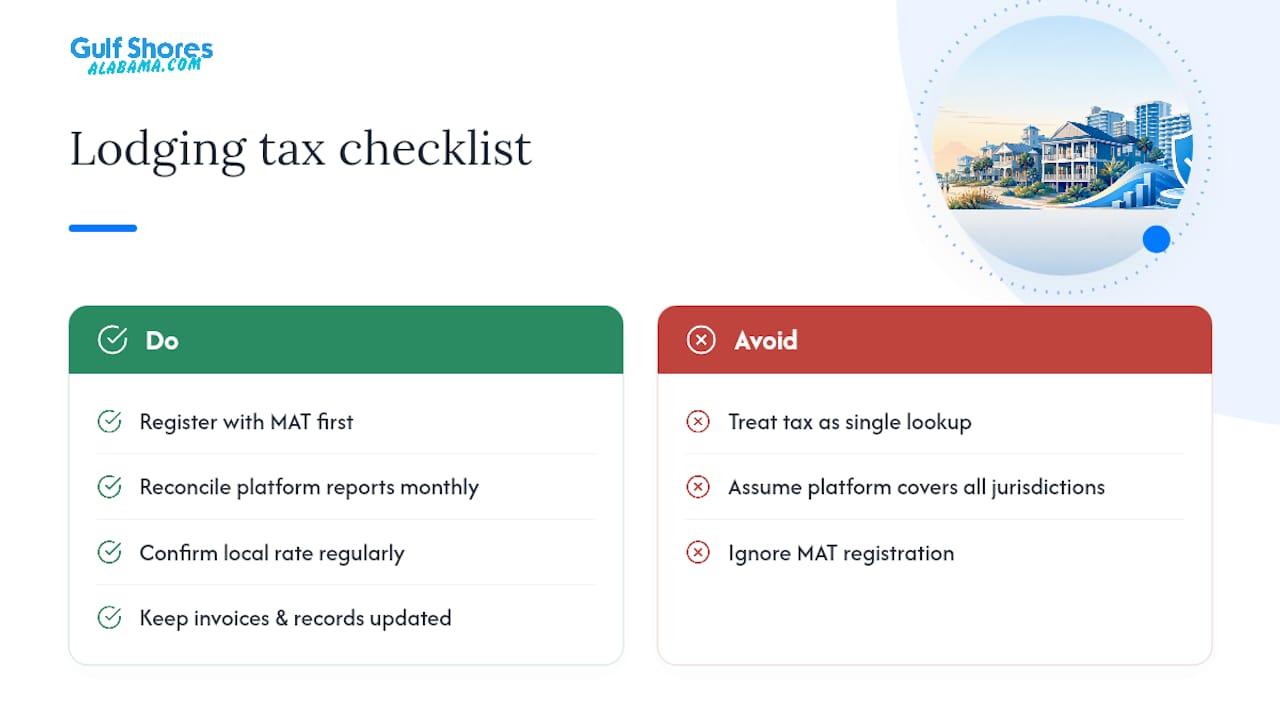
Conventional advice treats lodging tax like a single number you look up once and forget. That’s backwards. Your local rate can change when a municipality passes a new ordinance, and platform collection doesn’t always cover every jurisdiction correctly. I’d argue the owners who stay out of trouble aren’t the ones who understand tax law best. They’re the ones who reconcile their platform reports against ALDOR requirements every single month, treating it as routine bookkeeping rather than an annual scramble.
If you take one thing from this guide, make it registration first. A property earning rental income without an active MAT account is exposed regardless of whether the tax gets collected somewhere upstream. Everything else- rate confirmation, invoice formatting, recordkeeping- builds on that foundation.
— Joe
List Your Gulf Shores Rental Where Guests Are Already Looking
Getting your tax registration squared away is half the compliance picture. The other half is actually filling your calendar, and that can be achieved by connecting your property directly with travelers searching for beachfront condos, private homes, and pet-friendly cottages in Gulf Shores, Orange Beach, and Fort Morgan, allowing guests to book without going through a middleman.
Listing your property doesn’t change your tax obligations. You’ll still need an active My Alabama Taxes account and a confirmed local rate for your specific address, no matter how guests find you. But pairing solid compliance with strong visibility is how owners actually fill their booking calendar season after season. Ready to reach more travelers directly? List your property on Gulf Shores Vacation Rentals and start connecting with guests searching for exactly what you offer.
Where to Verify Alabama Lodging Tax Rules
- ALDOR’s lodgings tax FAQ page for current rates, due dates, and discount rules
- The My Alabama Taxes portal for registration, filing, and remittance
- Your county or municipal revenue office for locality-specific rates
Sources
- Lodgings Tax - Alabama Department of Revenue
- Lodgings tax - Alabama Department of Revenue (sales & use page)
- Rule 810-6-5-.13 Persons, Firms, And Corporations Subject To Lodgings Tax
- My Alabama Taxes
Recommended
- Short-Term Rental Laws Gulf Shores Owners Must Follow
- Property Management Gulf Shores AL: 2026 Owner’s Guide
- Gulf Shores vs Destin: Which Is Best for Rental Owners?

About the Author
Joe Godar of the GulfShoresAlabama.com Editorial Team creates destination guides, vacation-planning resources, and local travel content focused on Gulf Shores, Orange Beach, and Fort Morgan, Alabama.
Our team researches Alabama Gulf Coast beaches, vacation rental trends, family activities, local attractions, restaurants, events, and direct-booking best practices. Every guide is created to help travelers plan more confidently, discover the best of the Alabama Gulf Coast, and avoid unnecessary third-party guest service fees.
GulfShoresAlabama.com is part of the Emerald Coast by Owner marketing family, connecting travelers directly with verified vacation rental hosts throughout the Gulf Coast since 2016.
This article was reviewed for accuracy and updated using local destination research and current Alabama Gulf Coast vacation rental market insights.