
Set a moderate-to-flexible cancellation policy as your standard, then tighten the rules for peak dates and holidays. That combination gives you the best of both worlds: more bookings and stronger search visibility without a meaningful jump in cancellations. Evolve’s A/B test backs this up directly. When the company shifted a batch of listings to a more flexible policy, bookings rose 26% and revenue per listing climbed 53%, while cancellation rates stayed roughly flat.
Before you do anything else, take three steps:
-
Update your listing policy to a flexible or moderate tier as your default setting.
-
Add precise cancellation language to your rental agreement, including exact refund cutoffs and time zones.
-
Turn on one safeguard, whether that’s a refundable security deposit, guest ID verification, or a recommended travel insurance product.
Quick fact: Vrbo’s own partner data shows flexible-policy listings convert better and surface more often in “free cancellation” searches than strict-policy competitors, with no significant rise in cancellations reported.
Key Takeaways
A moderate-to-flexible cancellation policy, backed by peak-date exceptions and a refundable deposit or insurance safeguard, increases bookings without raising cancellation risk in any meaningful way.
| Point | Details |
|---|---|
| Default policy tier | Set moderate or flexible terms as your baseline across most of the calendar. |
| Reserve strict terms | Apply strict cutoffs only to named peak dates, not your entire booking calendar. |
| Pair flexibility with safeguards | Use refundable deposits, guest screening, and insurance to offset added exposure. |
| Test before rolling out | Pilot changes on a sample of listings for six to twelve weeks before a full switch. |
| List with Gulfshoresalabama | Owners can display clear, direct-booking cancellation terms on their own Gulf Shores listing. |
Table of Contents
-
What Are the Standard Vacation Rental Cancellation Policy Types?
-
How Do You Choose the Right Cancellation Policy for Your Property?
-
What Safeguards Let You Offer Flexible Cancellation Terms Safely?
-
How Do You Test a New Cancellation Policy Before Rolling It Out?
What Are the Standard Vacation Rental Cancellation Policy Types?
Every vacation rental cancellation policy falls into one of three tiers: flexible, moderate, or strict. The difference between them comes down to how much notice a guest needs to get a full refund, and each tier trades booking volume against revenue certainty differently.
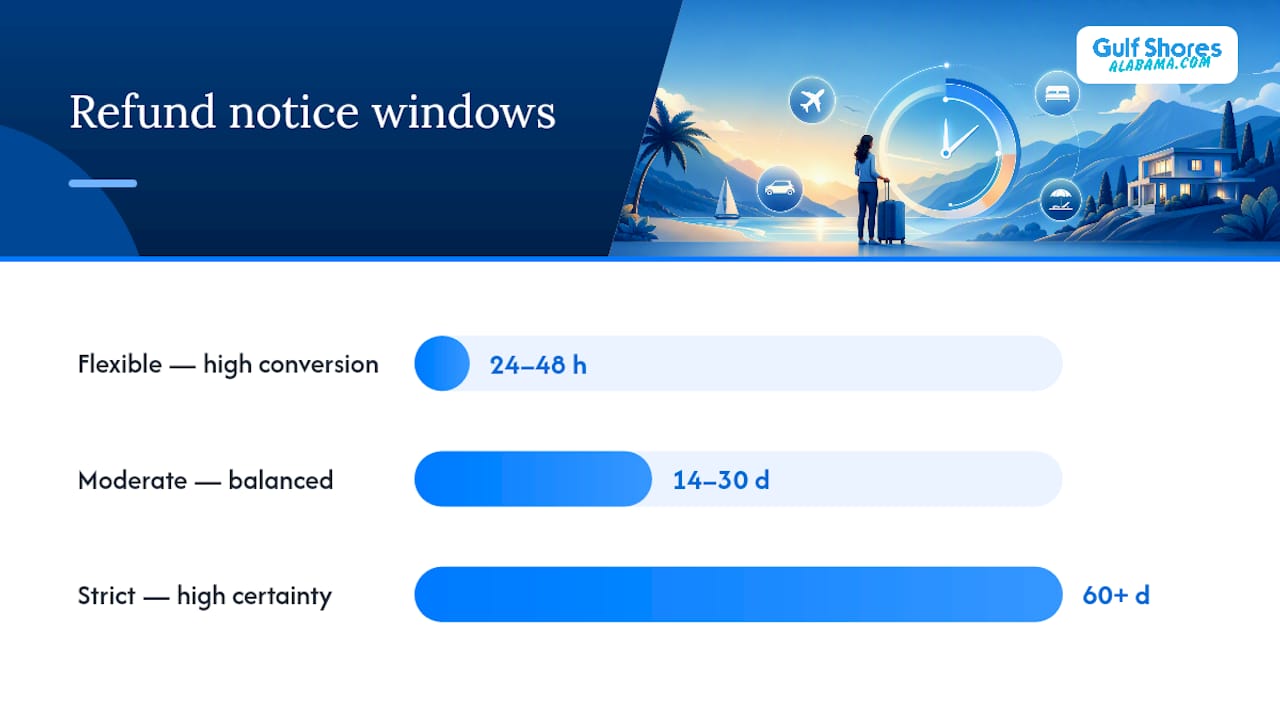
Flexible policies typically offer a full refund if a guest cancels 24 to 48 hours before check-in. This tier converts best because it removes the biggest objection browsers have: fear of losing money on a trip that might change. The tradeoff is thinner rebooking runway if someone cancels close to arrival.
Moderate policies usually refund in full up to 14 to 30 days out, then shift to a partial refund or no refund closer to the stay. This is the workhorse tier for most Gulf Coast properties. It gives you enough lead time to rebook a canceled slot while still looking reasonable to a guest comparing several listings.

Strict policies reserve full refunds for cancellations 60 or more days in advance, with steep penalties after that. This tier makes sense for high-demand peak weeks (spring break, July 4th, fall football weekends) where a canceled reservation is hard to backfill on short notice, but it depresses conversion for everyday bookings.
Sample listing language you can adapt:
-
Flexible: highest conversion, thinnest rebooking cushion.
-
Moderate: balanced default for most properties.
-
Strict: best reserved for named peak-date windows, not the whole calendar.
How Do Airbnb, Vrbo, and Vacasa Handle Cancellations?
Each major booking channel has its own cancellation infrastructure, and knowing the mechanics matters more than most owners realize when policies are set at the platform level.
Airbnb gives hosts a menu of tiers, from Flexible and Moderate up to Firm and Strict, plus a Long-Term option for stays of 28 nights or more and a Non-Refundable add-on that lets guests trade flexibility for a lower nightly rate. Airbnb also reserves a Super Strict tier for a small group of professionally managed listings that meet specific performance criteria.
Vrbo works from a similar template of relaxed, moderate, and strict policies, and it lets travelers filter search results by “free cancellation.” Listings that don’t offer flexible terms simply get excluded from that filter, which shrinks visibility before a guest ever opens the listing.
Managed-operator platforms like Vacasa often standardize policy language across an entire portfolio, which means individual property owners working with those operators may have less say over the exact terms guests see. It’s worth confirming, in writing, whether a management agreement lets you customize cancellation terms or whether the operator’s house policy simply overrides yours.
For anyone booking direct, most platforms let you set or edit cancellation policy from the listing settings dashboard, usually under a “policies” or “booking settings” tab. Check that setting quarterly, not just at onboarding.
-
Airbnb: tiered options plus Non-Refundable and Long-Term variants.
-
Vrbo: templated tiers tied to a “free cancellation” search filter.
-
Managed operators: portfolio-wide policies that may override individual owner preferences.
How Do You Choose the Right Cancellation Policy for Your Property?
Run through this checklist before locking in a policy, whether you’re setting terms for one condo or a whole portfolio:
-
Pull your market demand data. High-demand markets and peak seasons can support stricter terms without hurting conversion; slower shoulder seasons usually need flexibility to compete.
-
Check your typical booking lead time. Properties booked weeks or months out can afford moderate terms; last-minute-heavy listings do better with flexible windows that remove hesitation.
-
Weigh your nightly rate against guest price sensitivity. Higher-end properties often retain bookings even with stricter terms, since guests have already committed significant money and planning.
-
Factor in turnover and cleaning time. If your cleaning crew needs 48 hours between guests, a last-minute cancellation with no notice period costs you more than the refund itself.
-
Map your calendar for peak dates. Spring break weeks, holidays, and major local events are the windows where a strict exception policy protects you most.
-
Review last year’s cancellation and rebooking numbers. If cancellations rarely happened and rebooking was easy, flexibility carries low risk for your specific property.
The rule of thumb: default to moderate or flexible across your calendar, then layer strict terms onto specific named peak dates rather than applying them year-round. That targeted approach protects your highest-risk windows without dragging down conversion the other 300+ nights of the year.
Pro Tip: *Pull your last 12 months of booking data before changing anything.
Before rolling a new policy out across an entire portfolio, test it on a handful of comparable listings first. That scoped pilot is exactly how Evolve validated its results before expanding the flexible-policy approach company-wide.
What Safeguards Let You Offer Flexible Cancellation Terms Safely?
Flexibility only works long-term if you pair it with protections that limit your downside. These are the tactics experienced owners use to offer guest-friendly terms without absorbing unnecessary risk.
-
Refundable security deposits with a documented damage-claims process protect the property itself, separate from cancellation refunds.
-
Guest verification (ID checks, minimum review counts, and selectively limiting Instant Book for unverified guests) reduces the odds of a problem booking in the first place.
-
Travel or cancellation insurance shifts risk off your balance sheet entirely. Recommend it at checkout so guests can protect their own trip cost, and understand that claims and payouts run through the insurer, not you.
-
Peak-date exceptions let you keep a flexible baseline while applying stricter, date-specific rules to your highest-demand and hardest-to-rebook windows.
-
Payment schedules aligned to refund windows mean you’re never refunding more than what’s actually been collected at the time of cancellation.
-
Automated pre-stay messaging and house-rule reminders cut down on last-minute confusion and disputes that often trigger cancellation requests in the first place.
Pro Tip: If you manage pet-friendly properties, build your deposit and screening rules around pet-specific damage risk. A pet-friendly rental with a private pool has different turnover and cleaning stakes than a standard condo, and your policy should reflect that.
Readers weighing insurance options for their own trips can also point guests toward a dedicated travel insurance resource as part of pre-stay communication.
How Should You Write and Display Your Cancellation Policy?
Guests should see your cancellation terms in three places: a short summary line in the listing itself, the full legal language in the signed rental agreement, and a brief recap in the booking confirmation email. Each one reinforces the others and reduces the odds of a guest claiming they “didn’t know” the terms.
Your rental agreement needs a few non-negotiable clauses: the exact refund percentage or dollar amount at each cutoff, the specific date and time (in the property’s local time zone) those cutoffs take effect, whether cleaning fees are refundable, and force majeure language covering hurricanes, mandatory evacuations, or other events outside anyone’s control. Host guides consistently recommend documenting force majeure terms explicitly, since Gulf Coast properties face real hurricane-season exposure that inland rentals don’t.
One nuance owners miss: refunds should be calculated against what the guest has actually paid at the time of cancellation, not the full booking value, if you collect payment in installments.
-
Listing: short policy summary.
-
Rental agreement: full clause language.
-
Confirmation email: brief recap with dates.
| Point | Details |
|---|---|
| Refund cutoffs | State exact dates and times in the property’s local time zone. |
| Force majeure | Document hurricane and evacuation language separately from standard cancellation terms. |
| Signed record | Keep a signed agreement and written refund confirmation to prevent chargeback disputes. |
How Do You Test a New Cancellation Policy Before Rolling It Out?
Track four numbers before and after any policy change: booking conversion rate, cancellation rate, rebooking rate, and revenue per available night. Run the comparison for six to twelve weeks, or one full booking cycle if your typical lead time runs longer than that.
-
Split a sample of comparable listings into a control group (current policy) and a variant group (new policy).
-
Let the test run a full booking cycle before reading results, since early data skews toward whoever books soonest.
-
Treat a lift in conversion or revenue as meaningful only if cancellation rates hold steady, mirroring Evolve’s approach of using a targeted pilot before a full rollout.
-
Roll out portfolio-wide if the variant wins, iterate on the wording if results are mixed, or revert if cancellations spike.
Why the “Strict Is Safer” Assumption Doesn’t Hold Up
The instinct to protect revenue with a strict policy is understandable, but the data points the other way for most properties, most of the year. That’s not a fluke tied to one operator. Vrbo’s own search mechanics quietly punish strict listings by excluding them from “free cancellation” filters, which means a strict policy isn’t just a financial bet, it’s a visibility tax you pay on every single search a traveler runs.
Where conventional advice falls short is treating cancellation policy as an all-or-nothing choice. The smarter move is a hybrid: flexible or moderate as your default, strict carved out only for the two or three weeks a year you genuinely can’t afford an empty calendar. Owners who skip the safeguards, the deposits, the screening, the insurance nudge, and just flip to flexible cold are the ones who get burned. Pair the policy change with the protections, test it on a handful of listings first, and the risk drops to something manageable rather than theoretical.
— Joe
List Your Property With Gulfshoresalabama
Gulfshoresalabama gives you a direct-booking listing page where your cancellation terms, refund windows, and peak-date exceptions display exactly the way you write them, with no platform algorithm quietly overriding your policy or burying your listing for skipping a “free cancellation” filter.
That direct line to guests matters most for owners who’ve read this far: you can pair a moderate-to-flexible default with the safeguards covered above (deposits, screening, insurance) and communicate every clause without a third party reinterpreting it. Whether you manage a beachfront condo, a pet-friendly cottage, or a family-sized home near the marinas, a Gulfshoresalabama listing gives you full control over how your policy reads and how guests experience it before they ever book. Browse available Gulf Shores vacation rentals to see how current listings display their terms, or start the process of adding your own property today.
Sources
Recommended
About the Author
Joe Godar of the GulfShoresAlabama.com Editorial Team creates destination guides, vacation-planning resources, and local travel content focused on Gulf Shores, Orange Beach, and Fort Morgan, Alabama.
Our team researches Alabama Gulf Coast beaches, vacation rental trends, family activities, local attractions, restaurants, events, and direct-booking best practices. Every guide is created to help travelers plan more confidently, discover the best of the Alabama Gulf Coast, and avoid unnecessary third-party guest service fees.
GulfShoresAlabama.com is part of the Emerald Coast by Owner marketing family, connecting travelers directly with verified vacation rental hosts throughout the Gulf Coast since 2016.
This article was reviewed for accuracy and updated using local destination research and current Alabama Gulf Coast vacation rental market insights.